
Popular Paver Patterns & Layouts: Herringbone, Basketweave & More
Learn which paver patterns work best for patios, driveways, and walkways — including structural considerations and material waste percentages.
Why Pattern Matters
The pattern you choose for your paver installation affects far more than just aesthetics. Different patterns provide different levels of interlock — the mechanical bond between pavers that distributes weight and prevents shifting. A pattern that looks beautiful on a patio may not hold up on a driveway.
Pattern choice also affects your material cost. Some patterns, like herringbone, require more cuts at the edges, generating 5–10% more waste than simpler layouts. Your contractor should factor this waste into their material estimate.
Herringbone Pattern
Herringbone is widely considered the strongest paver pattern. Pavers are laid at 45° or 90° angles in a zigzag formation, creating exceptional interlock that resists lateral shifting under load. This makes herringbone the go-to choice for driveways and areas with vehicle traffic.
The 45-degree herringbone is the most visually dynamic and the strongest structurally. The 90-degree version is easier to install and creates a more orderly appearance. Both provide significantly more interlock than running bond or stack bond patterns.
Expect 8–12% material waste with herringbone due to the angled cuts required at borders. The installation is also more labor-intensive, which can add 10–15% to labor costs compared to simpler patterns.
Pro Tip
For driveways, 45-degree herringbone is the only pattern recommended by the Interlocking Concrete Pavement Institute (ICPI) for vehicular traffic areas.
Get Expert Help
Connect with verified contractors in your area who specialize in this work.
Start ProjectRunning Bond Pattern
Running bond — also called a stretcher bond — is the same pattern you see in most brick walls. Pavers are laid in offset rows, with each row shifted by half a paver length. It's simple, clean, and works with virtually any paver shape or size.
This pattern is excellent for walkways and patios. It provides moderate interlock and creates a sense of direction, which can be used to visually elongate a narrow space. Material waste is low at just 2–5%.
Running bond can be laid lengthwise, crosswise, or even diagonally for different visual effects. A diagonal running bond adds visual interest while maintaining the installation simplicity of the standard version.
Basketweave Pattern
Basketweave alternates pairs of pavers in horizontal and vertical orientations, creating a woven appearance. It's a traditional pattern that works beautifully with brick and concrete pavers in classic or colonial settings.
While visually appealing, basketweave provides less interlock than herringbone. It's suitable for patios and walkways but not recommended for driveways or areas with heavy loads. Material waste is moderate at 3–6%.
A variation called double basketweave uses two pavers in each direction instead of one, creating a bolder, more pronounced pattern that works well in larger spaces.
Ready to Start Your Project?
Get free, no-obligation quotes from top-rated hardscaping professionals near you.
Get Free QuotesCircular & Fan Patterns
Circular patterns — including fan, sunburst, and compass designs — create dramatic focal points in patios and courtyards. These patterns use specially shaped pavers (often wedge-cut) arranged in radiating arcs.
Fan patterns, also called European fan or cobblestone fan, evoke old-world charm and are popular for courtyard entries and patio centers. They require significant skill to install correctly and generate 15–20% material waste due to the complex cuts required.
Many homeowners use a circular pattern as a centerpiece within a larger field of simpler pavers. For example, a compass rose in the center of a herringbone patio creates a stunning visual anchor.
Pro Tip
Circular patterns require an experienced installer. Ask to see at least three completed circular projects in your contractor's portfolio before committing to this design.
Choosing the Right Pattern
Match your pattern to the space and use case. Driveways need herringbone for structural integrity. Walkways work well with running bond for its directional flow. Patios offer the most creative freedom — you can mix patterns, add borders, and incorporate circular focal points.
Consider the scale of your space. Large patterns with big pavers can overwhelm a small patio, while tiny pavers in a detailed pattern may look busy in a large space. As a rule of thumb, larger spaces can handle more complex patterns, while smaller areas benefit from simpler layouts.
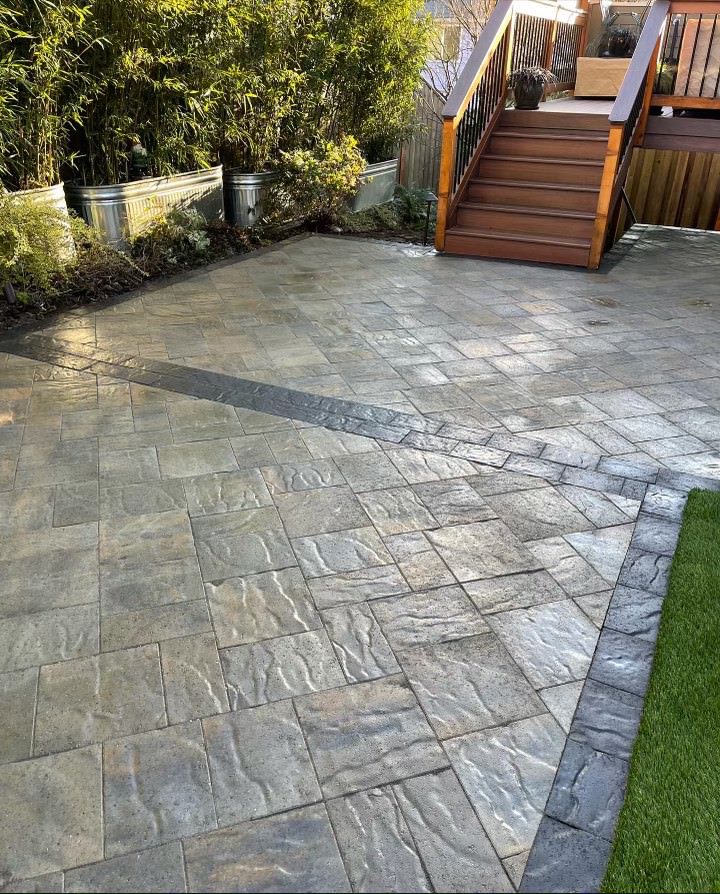
Don't forget the border. A contrasting border — either a different color or a different paver size — frames your pattern and creates a polished, finished look. Soldier course borders (pavers turned on their long edge) are the most common and add just $1–$3 per linear foot.
Have more questions about Pavers & Patios?
Get free quotes from verified hardscaping professionals in your area.
Start Project